Baker Hughes Wins Subsea Contract for Cyprus’s First Commercial Gas Project


Baker Hughes has won a subsea production systems contract from Eni for the Cronos gas field off Cyprus, the island’s first commercial gas development, the companies confirmed on October 28, 2026. The award, booked in the third quarter of 2026 and formally signed on October 26 in the presence of Cyprus’s energy minister and President Nikos Christodoulides, moves Cronos a step closer to first gas, targeted for the first half of 2028.
What Baker Hughes will actually deliver
The contract covers deepwater subsea trees, wellheads, connectors, manifolds, topside controls and related services for Cronos, which sits in Cyprus’s offshore Block 6. Baker Hughes says it will lean on standardized, configurable subsea equipment rather than a bespoke design, a choice the company frames as a way to shorten the time between a final investment decision and first production. Equipment deliveries are scheduled for the first half of 2027, roughly a year ahead of planned start-up. Baker Hughes executive vice president Amerino Gatti called the award “another important step” in the company’s relationship with Eni, which also includes separate work supporting Eni’s broader East Mediterranean and North African gas portfolio.
Who owns Cronos, and how big is it
Eni operates Block 6 with a 50% stake; TotalEnergies holds the other 50%. The partners took their final investment decision on Cronos in July 2026. Estimates put the gas initially in place at more than 3 trillion cubic feet, with production expected to plateau at up to 500 million standard cubic feet a day — equivalent to roughly 2.8 million tonnes per annum of LNG once fully ramped up. Eni already operates a second license, Block 8, offshore Cyprus and holds minority stakes in two further blocks operated by TotalEnergies, making the Italian major the most active single operator in Cypriot waters.
A first for Cyprus, built on Egyptian infrastructure
Cronos’ significance lies less in its size than in its status: it is the first gas discovery off Cyprus to reach a sanctioned commercial development, after more than a decade of exploration in the island’s exclusive economic zone. Rather than building new liquefaction capacity on Cyprus itself, the project will route gas by pipeline to Egypt, where it will be processed through existing infrastructure — including facilities tied to the Zohr field — before being liquefied at the Damietta LNG plant for export, mostly to European buyers. That arrangement mirrors how other recent Eastern Mediterranean discoveries have reached market, leaning on Egypt’s spare liquefaction capacity rather than new terminals, and it ties Cyprus’s energy future directly to Cairo’s pipeline and export network.
Another contractor in a crowded East Med supply chain
Baker Hughes is not the only contractor benefiting from Cronos. Eni awarded McDermott a project management, engineering, procurement and installation contract worth an estimated $500-750 million in September 2026, and press reporting has also named Dalmine and TechnipFMC among suppliers lining up work on the field. The flurry of awards reflects a broader pickup in Eastern Mediterranean gas activity, where Egypt, Cyprus and Israel have increasingly positioned their offshore basins as a near-term supply option for a Europe still working to replace Russian pipeline gas and absorb the extra costs the Iran war has added to the world’s LNG bill.
What happens between now and first gas
Between the October contract award and the targeted first-half-2028 start-up, the Cronos partners still have to complete subsea installation, tie back the wells to export infrastructure, and commission the Egyptian processing and liquefaction chain that will carry the gas to market. Baker Hughes’ choice of standardized subsea hardware is explicitly meant to compress that schedule: components that would otherwise be engineered field-by-field are instead drawn from a smaller, pre-qualified set of designs, cutting the lead time between ordering equipment and installing it offshore. For Cyprus, which has pursued offshore exploration since the early 2010s without previously reaching a sanctioned commercial project, Cronos’ progression from FID to contract awards within a few months is itself a signal that the island’s long-stalled gas ambitions are now moving on a firmer commercial timeline than in previous licensing rounds.
Sources
- Offshore Energy, “Baker Hughes’ subsea systems to help fast-track Cyprus’s first commercial gas project,” October 28, 2026 — contract scope, timeline, ownership.
- Offshore Engineer, “Baker Hughes to Supply Subsea Production Systems for Cronos Field off Cyprus,” October 2026 — equipment scope and company quote.
- Energy-Pedia, Cyprus Cronos award coverage, October 2026 — reserve and production estimates.
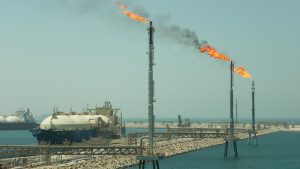
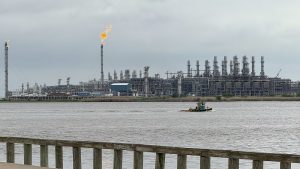
Illustrative image. Photo: GuavaTrain, CC0, via Wikimedia Commons — source