Samsung, Tesser, DNV and NTNU Join Forces on a Nuclear-Powered LNG Carrier


Samsung Heavy Industries, US reactor developer Tesser Atomics, classification society DNV and Norway’s NTNU university have signed a four-way memorandum of understanding to jointly develop a nuclear-powered LNG carrier concept, the partners announced this week, widening a project that began as a bilateral shipbuilder-reactor pact just a day earlier.
Dividing up the work on “DP1”
The agreement, signed November 20 at DNV’s headquarters in Høvik, Norway, covers what the partners call Demonstration Project 1, or DP1 — envisaged as an LNG carrier running a route between terminals in the United States and Europe. Samsung Heavy Industries (SHI) will lead vessel concept development and marine integration, including shipbuilding feasibility and construction methods. Tesser Atomics leads the reactor technology and the reactor-specific safety and licensing work. DNV contributes maritime safety and risk assessment, including a hazard-identification study and a roadmap for classification and verification. NTNU — whose Department of Ocean Operations and Civil Engineering chairs the consortium — coordinates research and funding proposals and, according to Tesser chief executive Per Peterson, acts as the project’s manager.
The four-way deal follows a narrower, exclusive agreement SHI and Tesser signed a day earlier, under which SHI becomes Tesser’s sole shipbuilder partner for the project and Tesser becomes SHI’s sole reactor supplier. “This additional agreement is important because it fills out the team that will develop DP1,” Peterson said. DNV’s director of approval ship classification, Ivar Håberg, called the pact “an important step towards the first modern full-scale nuclear-powered cargo vessel.”
A different reactor from Samsung’s earlier nuclear LNG work
The reactor at the center of DP1 is Tesser’s Triton design, a compact fluoride-salt-cooled high-temperature reactor (FHR) that uses TRISO fuel, a low-pressure molten-salt coolant and online refuelling — a distinct technology path from the small modular molten-salt reactor that Samsung and South Korea’s KAERI used in September 2025 to win an approval-in-principle from ABS and the Liberian Registry for a separate 174,000-cubic-metre LNG carrier concept. DP1 builds instead on Norway’s NuProShip research programme and continues within NTNU’s SFI SAINT nuclear-vessel research centre, of which Tesser is a member.
No party has disclosed a reactor output figure, construction timeline or cost estimate for DP1, and the partners describe the current stage as developing a safety-assessment framework and a roadmap toward design, construction and commissioning — not a construction decision. Samsung Heavy Industries executive Kyunghee Kim said nuclear propulsion is “one of the promising eco-friendly alternatives for transportation.”
Part of a wider push toward nuclear-powered shipping
DP1 is one of several nuclear-maritime efforts moving in parallel, arriving amid a broader surge in nuclear-sector dealmaking. ABS and HD Hyundai are studying a nuclear-electric propulsion system for a 16,000-TEU container ship; Lloyd’s Register has a joint development project with Zodiac Maritime, HD KSOE and KEPCO E&C covering bulk carriers and containerships; and in the US, Core Power has a cooperation agreement with the Maritime Administration aimed at a first nuclear-powered vessel by 2028, using propulsion technology already proven in nuclear-powered submarines and icebreakers. None of these projects has reached a final investment decision, and regulatory approval for nuclear propulsion on commercial cargo vessels remains untested at the International Maritime Organization.
Sources
- World Nuclear News, “Additional partners join nuclear-powered LNG ship project,” November 26, 2026 — partner roles, signing date and location, quotes, reactor technology, background on the September 2025 AiP.
- Seatrade Maritime, Container News and SeaNews, independent trade coverage of the November 20 Høvik signing — corroborating the four-way MoU and partner roles.
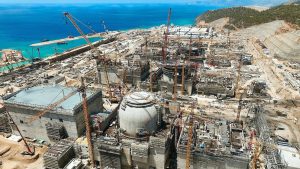
Illustrative image. Photo: Gordon Leggett, CC BY-SA 4.0, via Wikimedia Commons — source