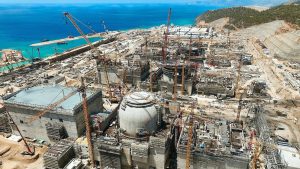
Rosatom Says Akkuyu’s First Fuel Loading Could Begin in December


Rosatom’s director general says the first real nuclear fuel assemblies could be loaded into Akkuyu Unit 1, Turkey’s first nuclear reactor, as early as December, putting the long-delayed plant on course to begin supplying the national grid in January or February 2027. The update came from Alexey Likhachev, speaking at a World Atomic Day session on the sidelines of the COP31 climate summit, which is being hosted in Turkey, and was reported by Rosatom’s in-house outlet Strana Rosatom and relayed by World Nuclear News.
A peer review clears a key hurdle
The announcement follows the completion of a pre-start-up peer review by the World Association of Nuclear Operators (WANO), which sent 17 experts from Belarus, Bulgaria, China, Russia, Slovakia and the United States to Akkuyu for more than two weeks. The team assessed the plant’s equipment condition, its operations and maintenance procedures, emergency preparedness, and fire and radiation protection systems, according to Akkuyu NPP, the Rosatom-controlled project company.
That review sits alongside a separate milestone reported by local media three days earlier: the completion of containment-integrity testing on the Unit 1 reactor building, one of the last structural checks required before hot functional tests. Akkuyu must still complete hot tests — in which reactor systems are run on an external power source rather than nuclear fuel — before real fuel can be loaded. Likhachev said Rosatom hopes those tests succeed in time for fuel loading to start in December.
“Loading real fuel into the first reactor vessel will begin as early as December,” Likhachev said, adding that “Turkey will receive this long-awaited nuclear electricity in January-February.”
A seven-year wait, nearly over
Akkuyu’s four VVER-1200 reactors, with a combined capacity of 4,800 MWe, are being built on Turkey’s Mediterranean coast in Mersin province under a build-own-operate model set out in a 2010 intergovernmental agreement between Ankara and Moscow. That agreement called for Unit 1 to be commissioned within seven years of all construction permits being issued; the construction licence was granted in 2018, and nuclear fuel was delivered to the site in April 2023. First concrete for the fourth and final unit was poured in July 2022. Once all four units are operating, Akkuyu is expected to supply roughly 10% of Turkey’s electricity — a scale that would make it the single largest addition to the country’s generation fleet in decades.
The project has slipped before: earlier schedules had pointed to commercial operation in late 2025 or early 2026. A December fuel-loading date, if it holds, would still leave Akkuyu short of generating power before the end of 2026, the original target, though Likhachev’s January-February window suggests the gap is now measured in weeks rather than years.
Ankara looks to bring in local investors
Likhachev also used the COP31 appearance to say Turkish entities have expressed interest in taking an equity stake in the project. The intergovernmental agreement allows non-Rosatom shareholders — subject to Turkish government approval — to hold up to 49% of Akkuyu. Likhachev said confidential talks are under way and that Turkish participation “will strengthen the project’s organisational and financial sustainability,” without naming the parties involved or a timeline for any transaction.
Akkuyu is the first of three planned plants
Turkish officials are already planning beyond Akkuyu. Energy Minister Alparslan Bayraktar said last week that talks with Canada and South Korea over new nuclear projects are expected to be finalised within months, part of a push that includes a second full-scale plant at Sinop on the Black Sea coast and a third proposed for the Thrace region, where Turkey is discussing options with Chinese partners. On Thursday, Canada’s AtkinsRéalis, through its Candu Energy unit, and Turkey’s state-owned TÜNAŞ signed a memorandum of agreement to carry out a feasibility study for a six-reactor, 4.5-gigawatt Candu plant — a separate initiative from the Sinop project. Turkey has also set a target of adding 5 GWe of small modular reactor capacity by 2050, equivalent to at least 16 individual SMR units.
For a government that imports the large majority of the oil and gas it burns for power, a working Akkuyu would mark the country’s first large-scale, low-carbon baseload source — and the first real test of whether Ankara can translate that into the broader nuclear fleet it has now started to plan.
Sources
- World Nuclear News, “Akkuyu 1 fuel loading ‘could start next month'”, 16 November 2026 — Likhachev quotes, WANO peer review details, project timeline and figures. world-nuclear-news.org
- Strana Rosatom, remarks by Rosatom Director General Alexey Likhachev at COP31 World Atomic Day session, as cited by World Nuclear News — primary source for fuel-loading and startup timeline.
- Daily Sabah, “Türkiye’s Akkuyu undergoes 1st reactor fuel loading test ahead of startup” — background on the June 2026 dummy fuel-assembly loading that preceded this announcement. dailysabah.com
Illustrative image. Photo: Nuclear Regulatory Commission, Public domain, via Wikimedia Commons — source