ACWA Power Signs $478 Million Water Deal for Dubai’s Hassyan Desalination Plant


Saudi developer ACWA Power disclosed to the Saudi Exchange (Tadawul) on October 28 that it has signed a 30-year water purchase agreement worth about $478 million (SAR 1.794 billion) with the Dubai Electricity and Water Authority (DEWA) covering the development, financing, construction and operation of a new reverse-osmosis desalination plant at Hassyan, south of Dubai. ACWA Power will hold a 40% stake in the project company.
What the plant will produce
The new Hassyan facility is designed to produce about 272,000 cubic metres of desalinated water per day, equivalent to roughly 60 million imperial gallons a day (MIGD), or close to 99 million cubic metres a year, once complete. The water purchase agreement sets out DEWA’s commitment to buy the plant’s output over three decades, the structure DEWA and its partners typically use to underwrite project financing for large-scale desalination in the emirate.
A second phase at the same site
The new agreement covers the second phase of the Hassyan independent water project; DEWA signed the first phase’s water purchase agreement in October 2023 for a plant with a nameplate capacity reported at around 180 MIGD. Trade press covering the UAE water sector puts the combined output of both phases at roughly 240 MIGD once the second phase is operational, making Hassyan one of the larger reverse-osmosis desalination complexes feeding Dubai’s water network. Neither ACWA Power’s disclosure nor DEWA’s statements reviewed for this article specify a construction timeline or commercial operation date for the new phase.
How the deal is structured
Independent water projects of this kind in the UAE are typically financed on a limited-recourse, project-finance basis: a special-purpose project company raises debt and equity against the long-term water purchase agreement, with DEWA’s commitment to buy the plant’s output providing lenders the revenue certainty needed to underwrite construction. ACWA Power’s 40% stake places it as a minority but strategic shareholder in the project company alongside DEWA and any additional partners, a structure the company has used across its wider portfolio of Gulf desalination and power assets. Neither ACWA Power’s disclosure nor the independent trade coverage reviewed for this article names the other shareholders in the Hassyan phase-two project company or the specific lenders expected to provide project debt.
Part of ACWA Power’s wider Gulf water and power portfolio
The Hassyan deal adds to a long list of water and power contracts ACWA Power has signed with DEWA and other Gulf utilities in recent years, part of a business mix that spans conventional and renewable generation alongside desalination. The Riyadh-listed company, one of the largest independent power and water producers in the Middle East and North Africa, has separately been central to Saudi Arabia’s renewable energy build-out and to UAE offshore gas and power infrastructure more broadly, where joint ventures such as the PTTEP-Eni Seela Energies venture at ADNOC’s Ghasha concession illustrate the scale of non-oil infrastructure investment underway in the emirate alongside desalination and power projects.
Dubai and the wider UAE have expanded desalination capacity over the past decade to reduce reliance on groundwater and to meet population and industrial growth, with DEWA shifting progressively toward reverse-osmosis technology, which uses less energy per cubic metre of water produced than older thermal desalination methods. Neither the company’s exchange filing nor independent coverage reviewed for this article disclosed the plant’s energy source or its expected power demand.
The deal follows ACWA Power’s start of commercial operations earlier this year at its Taiba 1 and Qassim 1 gas plants in Saudi Arabia, underscoring how the company continues to add both power generation and water assets to its balance sheet across the Gulf even as it pursues renewables growth targets. Reverse-osmosis plants such as Hassyan’s second phase typically consume substantially less electricity per cubic metre of water produced than the thermal multi-effect distillation plants the UAE relied on more heavily in past decades, a shift regional utilities have cited as a way to curb the energy intensity of desalination as water demand keeps rising with population and industrial growth.
Sources
- ACWA Power, disclosure to the Saudi Exchange (Tadawul), October 28, 2026 — contract value, term, capacity and ownership stake.
- MEED, “Acwa signs $478m Hassyan IWP deal in Dubai,” October 2026 — independent confirmation of contract terms and phase-one context.
- Trade Arabia, “Acwa Power signs $478m water purchase deal for Dubai desal project,” October 2026 — independent corroboration of capacity figures.
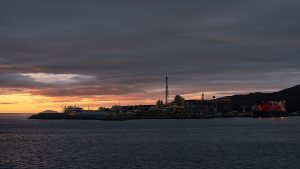
Illustrative image. Photo: giggel, CC BY 3.0, via Wikimedia Commons — source