Dogger Bank Wind Farm: Owners, Capacity and Timeline

Last updated: October 28, 2026
Dogger Bank Wind Farm is a 3.6GW offshore wind complex being built in the North Sea off the North East coast of England — the largest offshore wind project under construction anywhere in the world. Built in three 1.2GW phases (Dogger Bank A, B and C), it is a joint venture between Equinor, SSE Renewables and Vårgrønn, and is expected to supply enough electricity for close to 6 million UK homes a year once all three phases are fully operational.
Project Snapshot
| Project | Dogger Bank Wind Farm (Phases A, B, C) |
| Owners | SSE Renewables (40%), Equinor (40%), Vårgrønn (20%) |
| Developer / Construction lead | SSE Renewables |
| Operator | Equinor (for the project’s operational life, expected ~35 years) |
| Country / Location | United Kingdom — North Sea, 130–190 km off the North East coast of England |
| Technology | Offshore wind; GE Vernova Haliade-X turbines (13MW for A & B, 14MW for C); HVDC-based transmission to shore |
| Total capacity | 3.6GW (1.2GW per phase) |
| Investment | Approximately £9 billion (~$12bn) across all three phases |
| Financing | Project-financed; ~£4.8bn senior debt + ~£0.7bn ancillary facilities for A & B (2020); ~£2.5bn senior debt + ~£435m ancillary for C (2021), backed by 28+ banks and export credit agencies including UKEF, EKN and GIEK |
| Offtaker / revenue support | UK Contracts for Difference (CfD) with the Low Carbon Contracts Company — 15-year contracts at £39.65/MWh (Dogger Bank A) and £41.61/MWh (Dogger Bank B and C), 2012 prices |
| Announcement | CfD contracts signed October 2019; financial close on Dogger Bank A & B in November 2020, Dogger Bank C in December 2021 |
| Construction | Dogger Bank A — turbine installation complete (Feb 2026); Dogger Bank B — under construction; Dogger Bank C — under construction |
| Expected full operation | 2027 (per SSE/Equinor/Vårgrønn, as of the October 2025 project update) |
| Status | Commissioning (Phase A) / Under construction (Phases B and C) |
Ownership Structure
Dogger Bank Wind Farm is owned through a joint venture split 40% Equinor, 40% SSE Renewables and 20% Vårgrønn — a Norwegian renewables company jointly owned by HitecVision and Eni’s Plenitude. The 20% slice has changed hands twice: Eni (via Plenitude) originally bought into Dogger Bank A and B in February 2021 and into Dogger Bank C in February 2022, before transferring that 20% stake across all three phases to the newly formed Vårgrønn in October 2022. The Crown Estate’s seabed ownership register confirms the same 40/40/20 split was still in place as of its most recent published update (31 December 2024).
The three partners split roles clearly: SSE Renewables leads development and construction of all three phases, while Equinor will operate the wind farm once complete, for an expected asset life of around 35 years. Equinor’s UK offshore wind leadership sits under CEO Anders Opedal, who has named Dogger Bank among the company’s flagship renewables projects alongside its US and other European offshore assets.
Location and Scale
The wind farm sits on the Dogger Bank, a large sandbank in the North Sea, between 130km and 190km off the North East coast of England at its nearest points — among the furthest-from-shore offshore wind projects built to date. Its three phases will together house turbines rated at a combined 3.6GW: 1.2GW each for Dogger Bank A, B and C. SSE’s own published estimate puts annual output at enough to supply around 6 million UK homes (a footnoted figure of 5.85–6.42 million homes, depending on the load-factor assumption used).
Onshore, power from all three phases comes ashore through a 9km buried cable corridor connecting to the National Grid at Lackenby, near Teesside — a connection point shared with RWE’s separate Sofia offshore wind farm, though the two projects have different owners and are not otherwise linked.
Phases and Construction Status
| Phase | Capacity | Turbines | CfD strike price | Status (as of Oct 2026) |
|---|---|---|---|---|
| Dogger Bank A | 1.2GW | 95 × GE Vernova Haliade-X 13MW | £39.65/MWh (2023/24 delivery) | All turbines installed (Feb 2026); generating power during commissioning |
| Dogger Bank B | 1.2GW | 95 × GE Vernova Haliade-X 13MW | £41.61/MWh (2024/25 delivery) | Under construction; turbine installation under way (33 of 95 installed as of late July 2026, per SSE’s weekly operations notices) |
| Dogger Bank C | 1.2GW | 87 × GE Vernova Haliade-X 14MW | £41.61/MWh (2024/25 delivery, under its earlier “Teesside A” CfD) | Under construction; inter-array and export cable installation under way since 2025 |
The original target was full commercial operation across all three phases by 2026; that slipped, and as of the developers’ most recent public update (November 2025), the wind farm is expected to be fully complete in 2027. Dogger Bank A is generating electricity and feeding the UK grid during an extended commissioning period, but had not yet been declared in full commercial operation as of late October 2026. TDE will update the status field on this page as SSE, Equinor and Vårgrønn confirm further milestones.
A proposed fourth phase, Dogger Bank D, would add up to 1.5GW using part of the existing Dogger Bank C lease area. SSE and Equinor finalised a seabed lease for it with the Crown Estate in August 2025, but it still requires a Development Consent Order and a final investment decision before construction could begin.
Technology and Supply Chain
Dogger Bank uses GE Vernova’s Haliade-X turbine — among the most powerful offshore turbines in commercial use. Phases A and B each use 95 turbines rated at 13MW; Phase C uses 87 larger 14MW units, each with a 220-metre rotor diameter. GE Vernova is preparing turbine components for Phases B and C at the Maraen Port of Nigg in Scotland.
Key supply-chain contracts include DEME Offshore for the engineering, procurement, construction and installation of inter-array cables across all three phases (with Hellenic Cables manufacturing the 66kV cabling for Phase A); Seaway7 for monopile and turbine installation vessels; and NKT for the 320kV HVDC export cable system connecting the offshore platforms to the Lackenby landfall — a roughly £318m (€360m) contract covering both offshore and onshore cable sections.
Financing and Revenue Model
Dogger Bank A and B reached financial close in November 2020 on what was then described as the largest-ever offshore wind project financing: around £4.8 billion in senior debt plus roughly £0.7 billion in ancillary facilities, backed by a syndicate of commercial banks and export credit agencies including the UK’s UKEF, Sweden’s EKN and Norway’s GIEK, at 65–70% gearing. Dogger Bank C followed with its own financial close in December 2021, covering roughly £2.5 billion in senior debt plus about £435 million in ancillary facilities from 28 banks and three export credit agencies. Combined investment across all three phases is estimated at around £9 billion (~$12bn).
Revenue is underpinned by 15-year Contracts for Difference (CfD) with the UK government’s Low Carbon Contracts Company, won in the September 2019 Allocation Round 3 auction: Dogger Bank A secured £39.65/MWh, and Dogger Bank B and C each secured £41.61/MWh (both in 2012 prices). Under the CfD mechanism, the government tops up the project’s revenue when wholesale power prices fall below the strike price, and the project pays back the difference when prices rise above it — a structure designed to give project financiers predictable, de-risked cash flow over a 15-year window.
Economic Impact
An independent economic impact report commissioned by SSE, Equinor and Vårgrønn (BVG Associates, published November 2025) estimated Dogger Bank’s lifetime UK economic contribution at £6.1 billion in GDP terms, with around 3,600 full-time-equivalent UK jobs supported in 2025 alone across construction, ports and the wider supply chain.
How Dogger Bank Compares
Dogger Bank’s scale and UK CfD-backed financing model sit alongside other major North Sea offshore wind build-outs, including Ofgem’s separate £3.5 billion transmission tender for Ørsted’s Hornsea 3 project. Both illustrate how UK offshore wind at gigawatt scale increasingly depends on competitive, government-backed financing structures — CfDs for generation revenue, and competitively tendered transmission assets for grid connection — a different regulatory model from the permit-based US offshore wind projects that have faced legal and political challenges, such as the Trump administration’s attempt to revoke permits for Revolution Wind and two other US offshore projects. For more on how CfD strike prices compare with other cost benchmarks, see TDE’s explainer on LCOE (Levelized Cost of Electricity).
Related Entities
- Equinor — 40% owner and future operator
- Anders Opedal — Equinor CEO
- SSE Renewables — 40% owner, development and construction lead (profile forthcoming on TDE)
- Vårgrønn — 20% owner, joint venture of HitecVision and Eni’s Plenitude (profile forthcoming on TDE)
- TDE Companies hub
- TDE Investments hub
Sources
- Dogger Bank Wind Farm — official project site
- Dogger Bank — ownership history (Vårgrønn stake acquisition)
- The Crown Estate — offshore wind farm ownership register
- Equinor — Dogger Bank A inter-array cable completion
- SSE Renewables — Dogger Bank project page
- Wikipedia — Dogger Bank Wind Farm (for discovery; cross-checked against primary sources above)
- OffshoreWind.biz — AR3 CfD strike prices for Dogger Bank A, B and C (Teesside A)
- OffshoreWind.biz — Dogger Bank A & B financial close (Nov 2020)
- Renewable Energy World — Dogger Bank C financial close (Dec 2021)
- Offshore Engineer — GE Haliade-X 14MW turbines for Dogger Bank C
Frequently Asked Questions
Who owns Dogger Bank Wind Farm?
Dogger Bank Wind Farm is owned by a joint venture of SSE Renewables (40%), Equinor (40%) and Vårgrønn (20%). SSE Renewables leads development and construction; Equinor will operate the completed wind farm.
How many homes will Dogger Bank Wind Farm power?
SSE estimates the completed 3.6GW project will generate enough electricity to supply close to 6 million UK homes a year, based on a typical offshore wind load factor.
How big is Dogger Bank Wind Farm?
It has a total capacity of 3.6GW, split into three 1.2GW phases (A, B and C), making it the largest offshore wind farm under construction in the world.
Is Dogger Bank Wind Farm operational yet?
Partially. Dogger Bank A has all its turbines installed and is generating power during an extended commissioning period; Dogger Bank B and C remain under construction. The developers expect the full 3.6GW project to be complete in 2027.
What turbines does Dogger Bank Wind Farm use?
Dogger Bank A and B each use 95 GE Vernova Haliade-X turbines rated at 13MW; Dogger Bank C uses 87 larger Haliade-X turbines rated at 14MW.
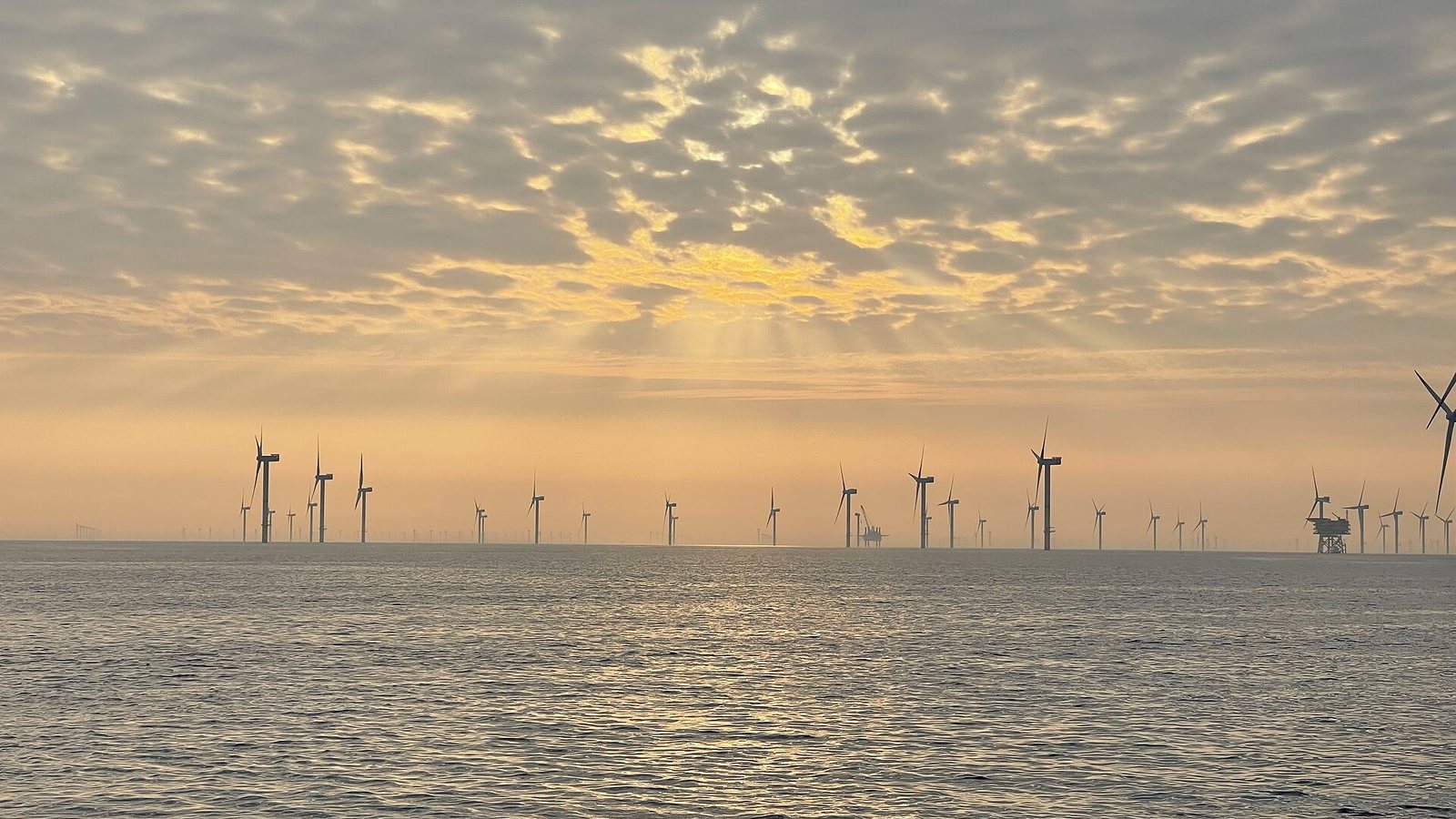
Illustrative image. Photo: Capmat007, CC BY-SA 4.0, via Wikimedia Commons — source