How Do Wind Turbines Work?

How do wind turbines work? They capture the kinetic energy of moving air with rotating blades, turn that rotation into mechanical power in a shaft, and use a generator to convert it into electricity that flows into the grid. The principle is simple, but the engineering behind a modern turbine, from blade shape to control software, is what makes it efficient and safe. This guide explains the process step by step, the main types, and where wind power helps and where it struggles.
What Is a Wind Turbine? A Simple Definition
A wind turbine is a machine that converts wind into electricity. Wind is air in motion, and moving air carries energy that depends on air density, the area the blades sweep, and above all wind speed. Because power rises with the cube of wind speed, a small increase in wind makes a big difference to output. A turbine in steady 12 metres per second wind produces far more than one in 6 metres per second, even though the wind is only twice as fast.
How Do Wind Turbines Work Step by Step
- Wind meets the blades. Blades are shaped like aircraft wings. Moving air creates lift on them, which makes the rotor spin.
- The rotor turns a shaft. The rotor, made up of the blades and hub, drives a low-speed shaft. Large turbines rotate slowly, often in the range of 10 to 20 revolutions per minute.
- A gearbox raises the speed. In many designs a gearbox increases the rotation to the speed a generator needs. Direct-drive designs skip the gearbox and use a larger generator instead.
- The generator makes electricity. Spinning magnets and coils produce alternating current by electromagnetic induction.
- Power electronics condition the output. Converters match the electricity to grid frequency and voltage.
- A transformer steps up the voltage. The power then travels through cables to a substation and into the grid.
Sensors and controllers keep this process safe. The yaw system turns the nacelle to face the wind, the pitch system rotates the blades to adjust how much wind they catch, and brakes stop the rotor in storms or faults. Most turbines start producing power at roughly 3 to 4 metres per second, reach rated output at moderate to strong wind, and shut down in very high wind to protect the equipment.
The main parts of a wind turbine
- Rotor and blades: capture the wind; usually three blades made of fibreglass or carbon composites.
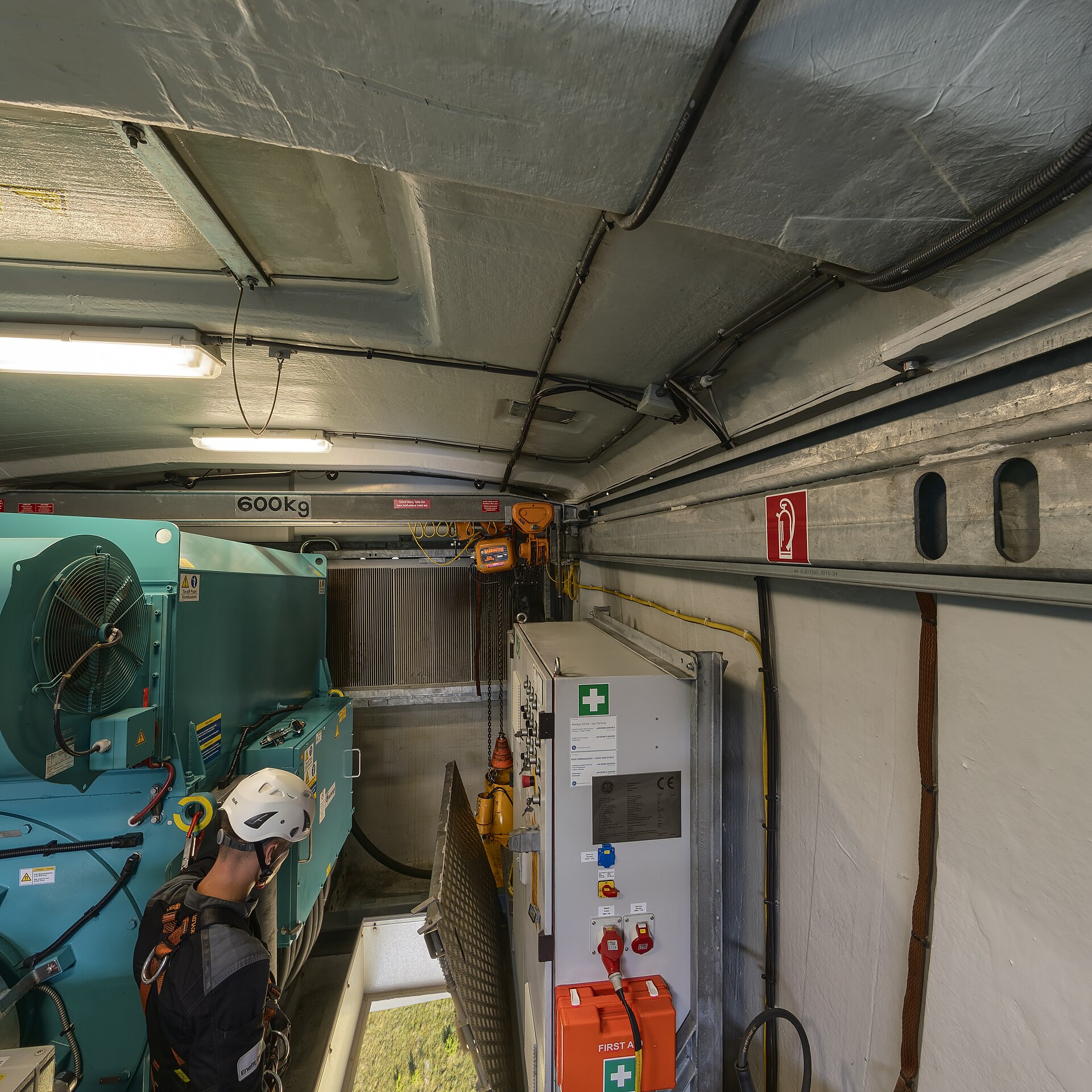
- Nacelle: the housing on top of the tower that holds the drivetrain, generator and controls.
- Tower: raises the rotor into stronger, steadier wind; usually steel, sometimes concrete.
- Foundation: a concrete base on land, or a monopile, jacket or floating structure offshore.
- Control system: monitors wind, vibration and temperature, and adjusts the turbine in real time.
Key Types and Technologies of Wind Power Generation
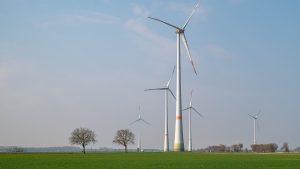
The most common design is the horizontal-axis wind turbine, with a rotor facing the wind on top of a tall tower. Vertical-axis turbines exist, but they are rare in large-scale generation.
| Type | Where used | Notes |
|---|---|---|
| Onshore horizontal-axis | Plains, ridges, coastal land | Lowest installed cost; the bulk of global capacity |
| Offshore fixed-bottom | Shallow seas | Stronger, steadier wind; higher cost for foundations and maintenance |
| Offshore floating | Deep water | Opens areas where fixed foundations are not practical; still early in commercial roll-out |
| Small wind | Farms, remote sites, microgrids | Serves local loads, often with batteries |
Another technical choice is between geared and direct-drive generators. Gearboxes are proven but need maintenance. Direct-drive machines cut moving parts but use more permanent magnets, which raises material and supply-chain questions.
Main Advantages and Limitations
Advantages
- No fuel is burned, so operation produces no direct carbon dioxide emissions.
- Fuel is free, which protects generators from fuel price swings.
- Land under onshore turbines can still be used for farming or grazing.
- Projects can be built in modules and expanded over time.
Limitations
- Variability: output changes with the wind, so grids need flexibility from storage, gas, hydro, demand response and interconnection.
- Siting: good wind sites may be far from demand, which requires new transmission lines.
- Local impacts: noise, visual change and effects on birds and bats need careful planning and monitoring.
- Materials and recycling: composite blades are hard to recycle, and the industry is developing solutions.
Costs, Efficiency and Market Role
No turbine can capture all of the wind’s energy. The theoretical maximum is the Betz limit, which is about 59 percent. Real turbines convert less than that after mechanical and electrical losses, but modern designs get close enough that the main gains now come from bigger rotors and taller towers rather than from basic efficiency.
Two terms matter when comparing projects:
- Capacity factor: the actual energy produced divided by the maximum possible if the turbine ran at full power all the time. Onshore sites typically land well below offshore sites, which often reach higher values.
- Levelised cost of electricity: the average cost per unit of electricity over the project’s life, including construction, financing and operation.
Over the past decade, onshore wind has become one of the cheapest sources of new electricity in many markets, according to analysis by agencies such as IRENA. Offshore wind costs more but delivers larger volumes with higher capacity factors. Costs vary by country, interest rates and supply-chain conditions, so check the latest reports for your market.
Global installed wind capacity passed one terawatt (1,000 gigawatts) in 2023, according to the Global Wind Energy Council. Wind now supplies a meaningful share of electricity in countries such as Denmark, Ireland, Germany and the United Kingdom.
Leading Countries and Companies
China leads the world in installed wind capacity by a wide margin, followed by the United States and Germany, with India, Spain and Brazil also in the top group. Major turbine makers include Vestas, Siemens Gamesa, GE Vernova, Nordex, Goldwind, Envision and Mingyang. Chinese manufacturers have expanded quickly in recent years, and competition on price and size is intense.
Future Outlook for Wind Turbines
Several trends are clear. Turbines keep growing, with offshore machines now reaching rated outputs in the double-digit megawatts. Floating foundations aim to unlock deep-water resources. Digital monitoring and predictive maintenance lower downtime. Hybrid projects combine wind with solar and batteries. Repowering replaces old turbines with fewer, larger ones on the same site.
The main constraints are grid connection delays, permitting timelines, supply-chain pressure and financing costs rather than basic technology.
How Do Wind Turbines Work? Frequently Asked Questions
How much wind do turbines need?
Most start generating at about 3 to 4 metres per second and shut down at very high speeds, often around 25 metres per second, to avoid damage.
Why do most turbines have three blades?
Three blades balance efficiency, smooth loading and cost. Two blades are cheaper but spin less smoothly, and more than three add cost with limited gain.
What happens when the wind stops?
The turbine produces no power, and the grid relies on other sources such as hydro, gas, storage or imports.
How long do wind turbines last?
Typical design lives are around 20 to 25 years, and some are extended or repowered after that.
Are wind turbines noisy?
Modern turbines are quieter than older ones, and regulators set minimum distances and noise limits for homes.
Conclusion
So, how do wind turbines work in practice? Blades turn moving air into rotation, a drivetrain and generator turn that rotation into electricity, and power electronics deliver it to the grid. The technology is mature, and its strengths are low operating cost and no fuel burn. Its challenges are variability, siting and grid access. Understanding these basics makes it easier to judge news about wind projects, costs and policy.
Sources and further reading
- U.S. Department of Energy, Wind Energy Technologies Office (energy.gov)
- International Renewable Energy Agency, renewable power generation costs (irena.org)
- Global Wind Energy Council, Global Wind Report (gwec.net)
- International Energy Agency, wind electricity tracking (iea.org)