BP Company Profile: History, Business and Strategy

The BP company is one of the world’s largest integrated energy groups, headquartered in London and listed on the London Stock Exchange. It began in 1909 as the Anglo-Persian Oil Company and today produces oil and gas, trades energy, refines and markets fuels, and invests in low-carbon businesses. This profile covers the group’s history, ownership, main business segments, key assets, strategy shifts and career routes, with pointers to the primary sources for current figures.
BP Company at a Glance
BP is a publicly listed company with a broad shareholder base, mostly institutional investors, and shares also traded in the US as American depositary shares. It is one of the group often called the oil and gas “supermajors”, alongside ExxonMobil, Shell, Chevron and TotalEnergies. The company writes its brand as “bp” in lower case, and its public reporting follows international financial reporting standards.
- Headquarters: London, United Kingdom
- Origins: founded in 1909 as the Anglo-Persian Oil Company
- Core activities: upstream oil and gas, gas and low-carbon energy, customers and products (fuels, convenience retail, lubricants, EV charging)
- Footprint: operations and sales in dozens of countries across the Americas, Europe, Africa, the Middle East, Asia and the Caspian region
For current revenue, profit, production and employee numbers, use the latest annual report and the quarterly results published on bp.com, since these change every reporting period.
History and Ownership of the BP Company
From Persia to a global group
The firm traces its roots to a 1908 oil discovery in Persia (today’s Iran), which led to the formation of the Anglo-Persian Oil Company the following year. The British government bought a controlling stake shortly before the First World War, to secure fuel for the Royal Navy. The company became the Anglo-Iranian Oil Company in the 1930s and adopted the name British Petroleum in the 1950s, after Iran nationalised its oil industry.
North Sea, Alaska and privatisation
Losing Iranian assets pushed the company to look elsewhere. It helped develop Alaska’s Prudhoe Bay and became a pioneer of North Sea production, which reshaped its geography. The British government sold its remaining holdings in stages between the late 1970s and 1987, leaving BP fully in private hands.
Mergers and the Deepwater Horizon accident
In the late 1990s and early 2000s BP merged with Amoco and acquired ARCO and Burmah Castrol, which added large US positions and the Castrol lubricants brand. In 2010 the Deepwater Horizon drilling rig, operated for BP by a contractor, exploded in the Gulf of Mexico, killing eleven workers and causing a major oil spill. The accident led to large legal settlements, asset sales and a lasting emphasis on safety and risk management.
Russia and Rosneft
BP held a large stake in the Russian oil company Rosneft for years. After Russia’s invasion of Ukraine in February 2022, BP announced that it would exit that holding, a decision that reshaped its portfolio and balance sheet.
Core Business and Revenue Drivers
BP reports its activities in a small number of segments, and the exact labels have changed over time, so check the latest annual report. In broad terms:
| Area | What it does | Typical revenue drivers |
|---|---|---|
| Oil production and operations | Explores for and produces crude oil and some natural gas | Oil prices, production volumes, operating cost |
| Gas and low carbon energy | Natural gas, LNG, power, renewables, biogas and hydrogen projects | Gas prices, LNG contracts, project execution |
| Customers and products | Fuel retail, convenience stores, lubricants, EV charging, refining, aviation fuels | Refining margins, retail volumes, brand strength |
| Trading and shipping | Trades crude, products, gas and power; manages risk and logistics | Market volatility and trading skill |
As with other integrated majors, earnings swing with commodity prices. High oil and gas prices lift upstream profits, while refining and retail often behave differently and provide a partial cushion. The trading arm tends to earn more in volatile markets.
Key Assets, Projects and Markets
BP’s upstream portfolio is spread across several basins. The main regions include:
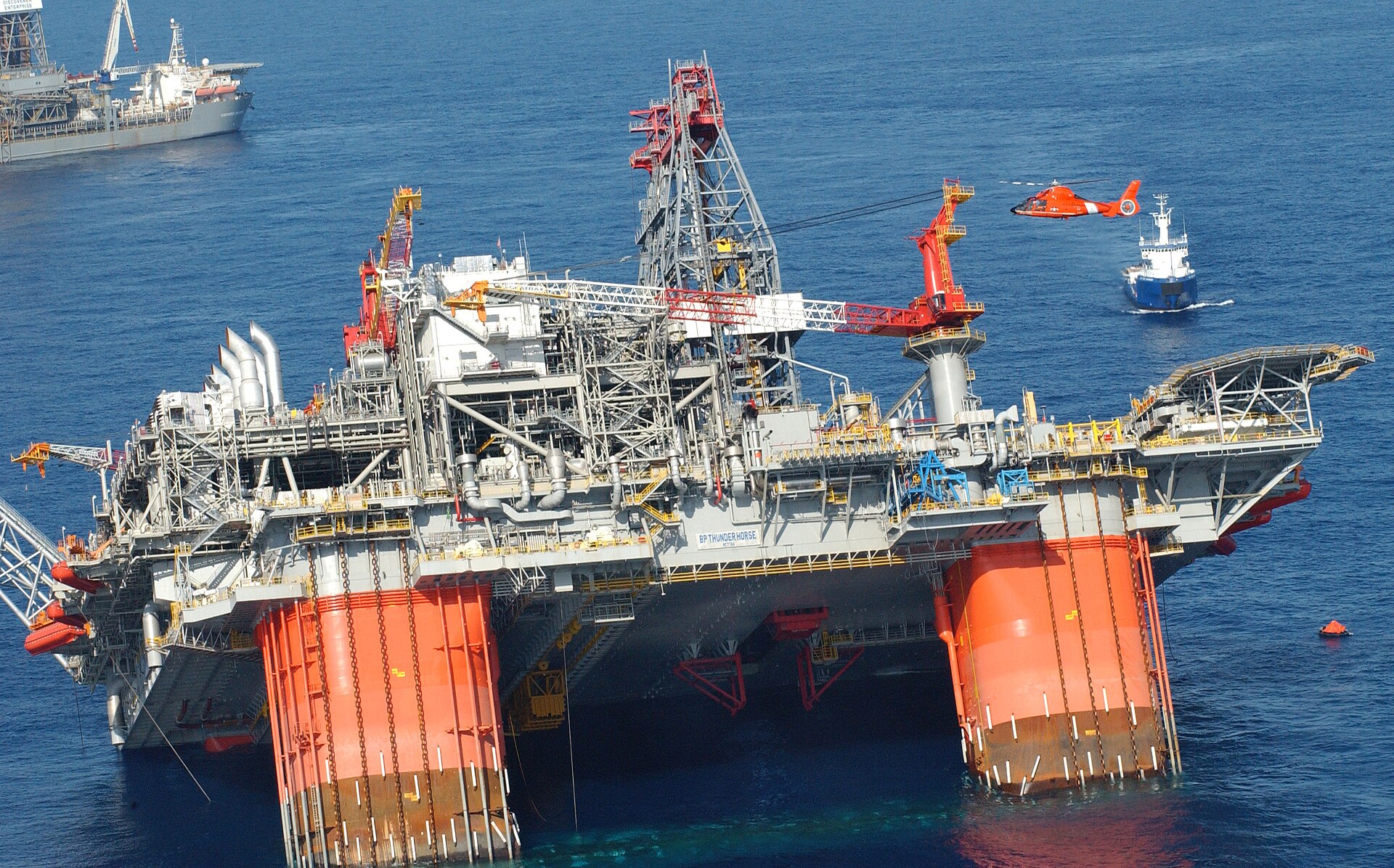
- Gulf of Mexico (US): deepwater platforms including Thunder Horse, Atlantis, Mad Dog and Argos
- North Sea: long-standing production hubs in UK and Norwegian waters, plus offshore wind interests
- Caspian region: operatorship of Azerbaijan’s major offshore fields, with a role in the Baku-Tbilisi-Ceyhan oil pipeline and the South Caucasus gas pipeline
- Middle East and North Africa: activity in Egypt, Oman and Iraq, including the Rumaila field
- West Africa: the Greater Tortue Ahmeyim LNG project offshore Mauritania and Senegal, developed with partners
Downstream, BP operates refineries in the US and Europe and a large fuel retail network, with the Castrol lubricants brand marketed worldwide. Ownership structures, stakes and operating status change often, so the annual report is the right place to confirm the current asset list.
Financial Performance and Scale
By revenue and production, the BP company is among the largest listed energy groups in Europe. Rather than quote a single year’s figures that will age quickly, it is more useful to know where the numbers come from and how to read them.
- Annual report and accounts: audited revenue, profit, capital expenditure, debt and reserves.
- Quarterly results: underlying replacement cost profit, which is BP’s preferred measure because it removes the effect of inventory price changes.
- Statistical reviews: the Energy Institute’s annual review of world energy, which took over the long-running series that BP published for decades.
- Regulatory filings: annual filings with US and UK authorities provide detail on risks, legal proceedings and reserves.
Key indicators to watch are operating cash flow, net debt, shareholder distributions (dividends and buybacks) and upstream production. Because the company’s profits track commodity prices, compare several years rather than a single result.
Strategy and the Energy Transition
BP’s strategy has changed noticeably over the last two decades. In 2000 it rebranded around “Beyond Petroleum” and invested in solar. In 2020 it set an ambition to become a net zero company by 2050 and planned a large shift of capital toward low-carbon businesses and away from oil and gas production. In 2023 it softened its near-term emissions reduction target for 2030, and in early 2025 it announced a reset: more investment in oil and gas, tighter spending on low-carbon projects and a focus on returns and cost discipline.
The BP company still invests in biofuels, EV charging through its bp pulse business, offshore wind, solar developments and hydrogen. But the balance between hydrocarbons and low-carbon spending has moved toward hydrocarbons relative to the earlier plan. Analysts and investors differ on whether this is prudent or a missed opportunity, and the plan may change again. Read the latest strategy update on bp.com for its current form.
Jobs and Careers at the BP Company
BP hires across engineering, geoscience, operations, trading, finance, digital, legal and customer-facing roles. Entry routes include graduate programmes, internships, apprenticeships and experienced-hire openings. Upstream roles usually ask for geoscience, petroleum, mechanical or chemical engineering degrees, while trading and finance roles favour quantitative backgrounds. Retail and convenience operations employ a large front-line workforce.
Applications go through the careers section of bp.com. Roles with offshore or field components typically include medical checks and safety training, in line with industry standards.
Frequently Asked Questions About the BP Company
What does BP stand for?
It stands for British Petroleum, the name the company used from the 1950s. The group now uses “bp” as its brand and has described itself as an integrated energy company.
Who owns BP?
BP is publicly traded, so ownership is spread among institutional and retail shareholders. No single government owns it today, although the UK state held a major stake in the twentieth century.
Where is BP headquartered?
The group is headquartered in London, with major regional offices in the US, Europe and elsewhere.
Is BP a renewable energy company?
Not mainly. Oil and gas still account for most of its profits, though it has renewable, biofuel, charging and hydrogen businesses.
How can I find BP’s latest financial results?
The investors section of bp.com publishes the annual report and quarterly results. Independent analysis is available from the Energy Institute and financial regulators.
Conclusion
The BP company has evolved from a Persian oil venture into a global energy group that produces hydrocarbons, trades energy, sells fuels and invests in lower-carbon projects. Its history shows repeated reinvention, from North Sea development to the Deepwater Horizon aftermath, the Rosneft exit and the strategy reset. To judge where it stands today, rely on its latest annual report, quarterly updates and independent reviews rather than older summaries.
Sources and further reading
- bp, annual report and investor materials (bp.com)
- Energy Institute, Statistical Review of World Energy (energyinst.org)
- London Stock Exchange, company disclosures (londonstockexchange.com)
- U.S. Securities and Exchange Commission, company filings (sec.gov)
- U.S. Bureau of Safety and Environmental Enforcement, Deepwater Horizon investigation material (bsee.gov)